How Do I Build a Cordless Tool Product Line Under My Own Brand?
Many buyers want a private-label cordless tool line fast. The risk starts when I choose random tools before I know the channel, kit, and first-order plan.
I build a cordless tool product line by starting with my sales channel, choosing a small test range, setting clear kit levels, preparing consistent packaging, and planning later expansion. I do not start with the cheapest tool. I start with the configuration that can sell in my market.
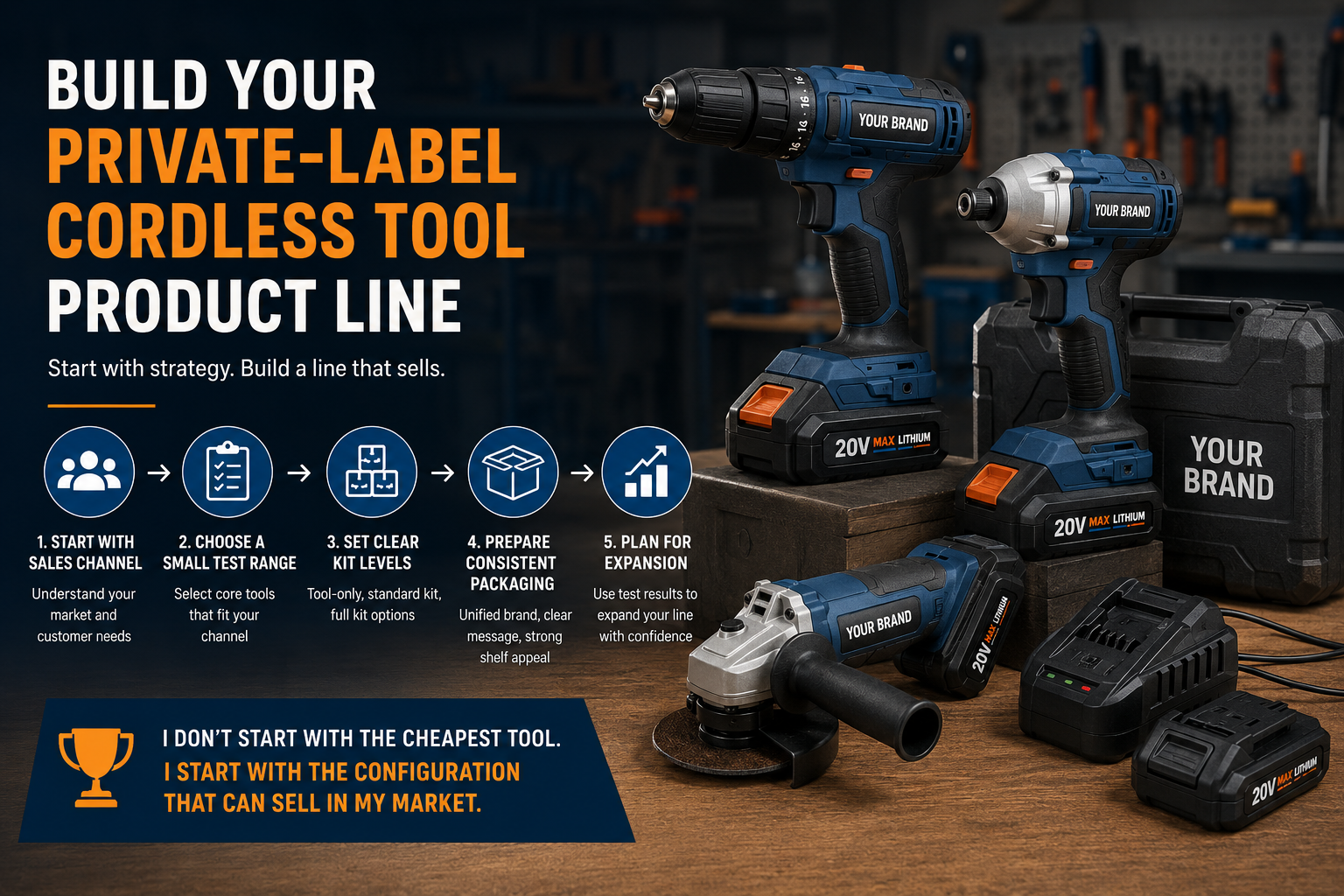
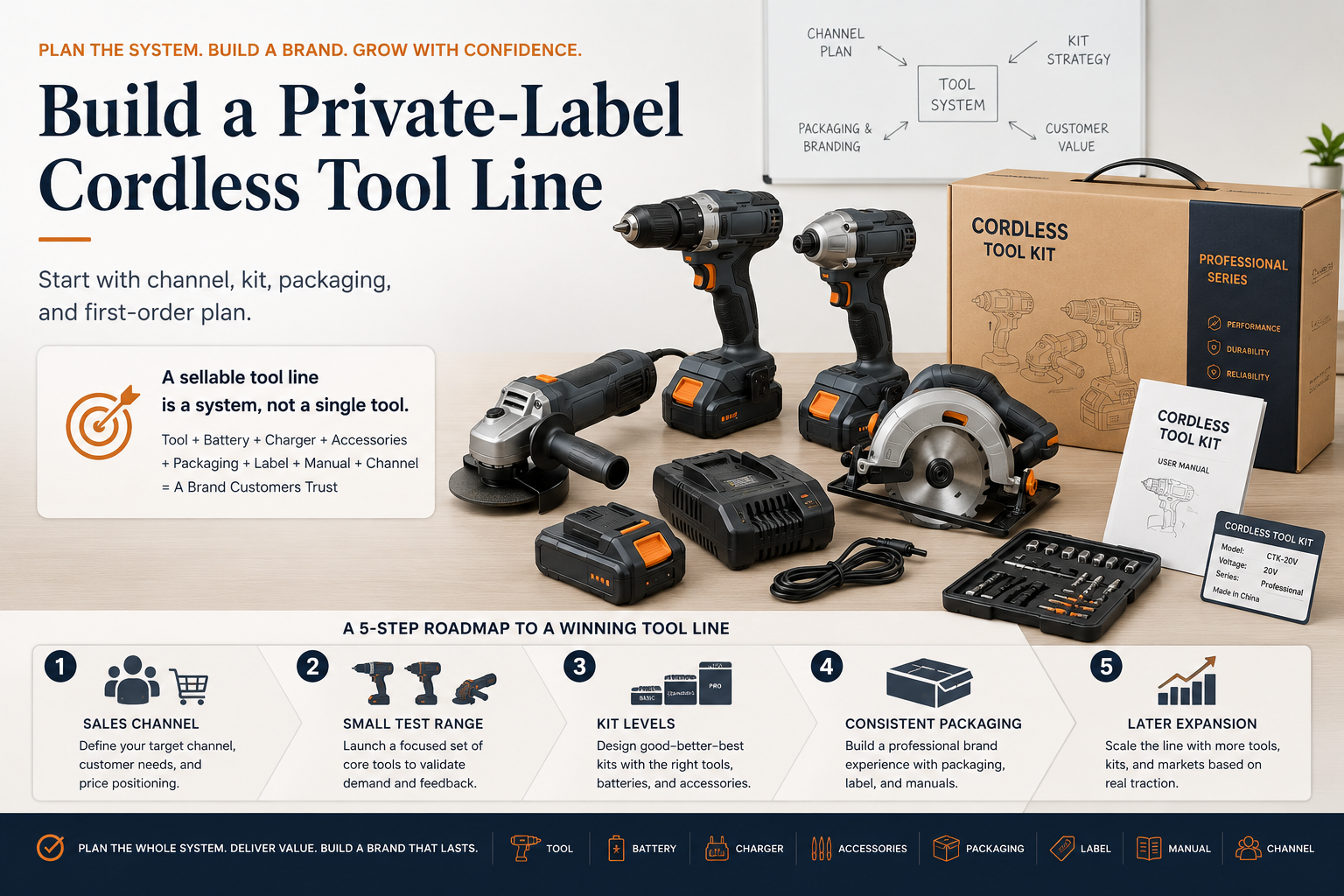
I have seen many sourcing talks begin with one simple question: “What is the price for this model?” That question matters. But it is not the full decision. A cordless tool line becomes sellable only when the tool, battery, charger, accessories, packaging, label, manual, and channel plan work together. I need to think like a product-line planner, not only like a buyer. If I treat the first order as a test, I can control risk and still build a clear path for my own brand.
Why Should I Start With My Sales Channel First?
A tool can look good on paper and still fail in the wrong sales channel. I need to match the product structure to how my customer buys.
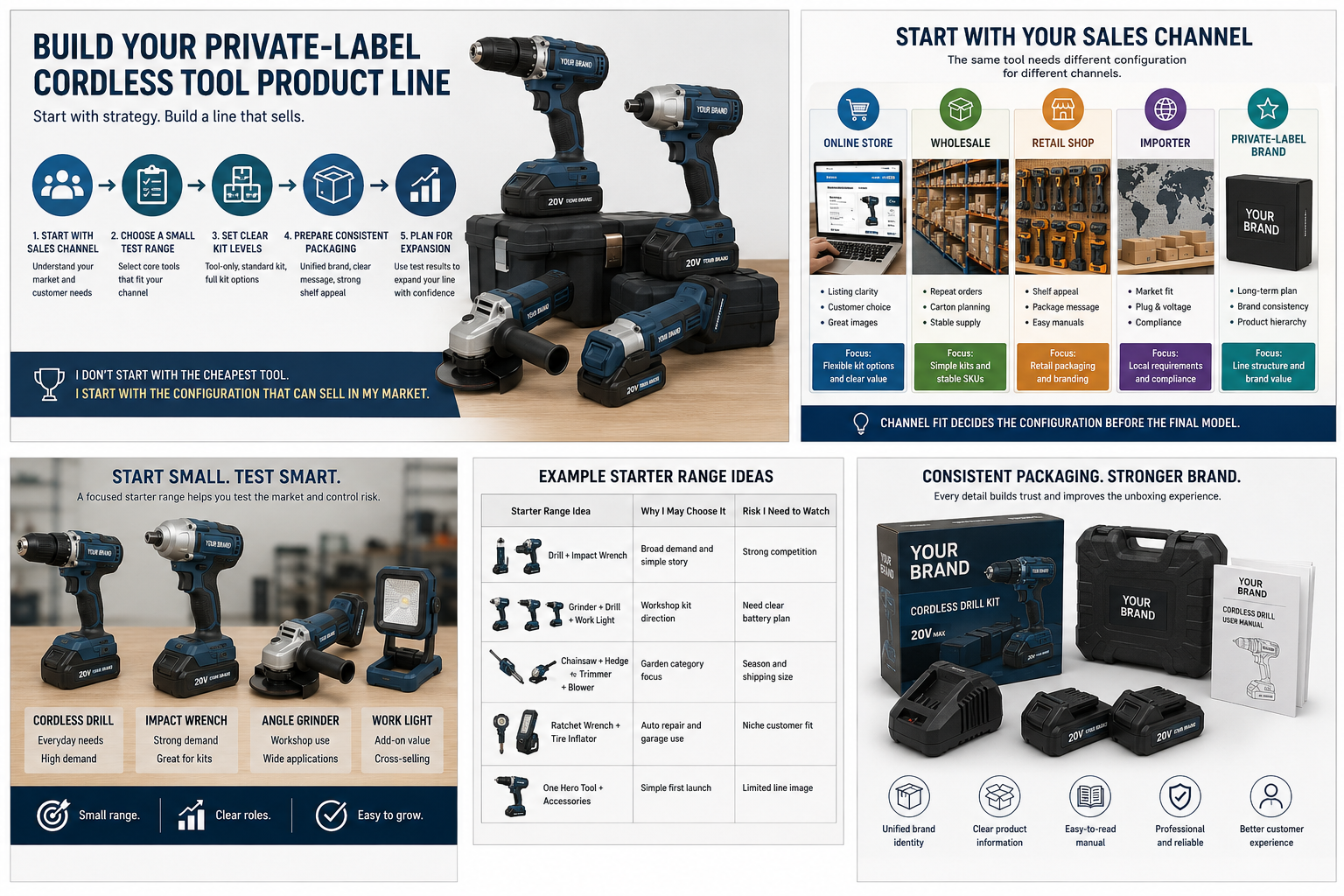
I start with my sales channel because the same cordless tool may need different kits, packaging, labels, and price points for online sales, wholesale, retail shops, or distributor programs. Channel fit decides the product configuration before I choose the final model.
I look at how the product will be sold
In sourcing discussions, I often see buyers ask for a hot model first. I understand this habit. It feels fast. But I usually bring the talk back to the sales channel. An online seller may need a product page with clear kit choices, good images, and simple package names. A wholesaler may care more about carton quantity, basic packaging, and stable repeat supply. A retail tool shop may need stronger shelf packaging and easy manual language.
I use the sales channel as the first filter. It helps me avoid a product line that looks large but feels messy to the market.
| Sales channel | What I usually check first | Common configuration focus |
|---|---|---|
| Online store | Listing clarity and customer choice | Tool-only, full kit, accessories |
| Wholesale | Repeat order and carton planning | Simple kits, stable SKUs |
| Retail shop | Shelf look and package message | Retail box, labels, manuals |
| Importer | Market fit and plug type | Charger plug, language, compliance needs |
| Private-label brand | Long-term line structure | Package style and product hierarchy |
I avoid copying another seller without context
I may see another seller offering a cordless impact wrench kit with two batteries and many accessories. That does not mean I should copy it. Their channel, price level, review base, and customer group may be different from mine. I need my own kit logic. A low-cost online test may begin with one tool-only option and one full kit. A retail plan may need fewer choices but stronger package design. A distributor plan may need a balanced offer that is easy to explain to dealers.
I use the channel to reduce risk
The first product line should not carry every possible tool. I prefer to use the first order to test demand, price response, package acceptance, and customer questions. The channel tells me where the risk is. For online sales, the risk may be weak conversion or unclear kit value. For wholesale, the risk may be too many slow-moving SKUs. For retail, the risk may be poor shelf appeal. When I know the channel, I can build a product line with a cleaner first step.
How Many Cordless Tools Should I Start With?
A large first catalog can look strong, but it can also create slow stock. I prefer a smaller starter range with clear roles for each tool.
I should start with a limited cordless tool range that tests the market without creating too many SKUs. I choose core tools based on channel demand, kit logic, battery platform plan, and future expansion, not only based on low unit price.
I treat the first range as a market test
I do not see the first private-label cordless tool line as a final catalog. I see it as a controlled test. The goal is to learn which tool type, kit level, battery capacity, and price point gets real response. If I start with too many tools, I may not know what caused the result. The line becomes hard to manage. Photos, manuals, labels, cartons, inventory, and customer service all become heavier.
A starter range can be small, but it still needs structure. I may select tools that serve different user needs. For example, an online seller may test a cordless drill, an impact wrench, and an angle grinder. Another buyer may focus on garden tools, such as a chainsaw, hedge trimmer, and blower. The right mix depends on the audience.
| Starter range idea | Why I may choose it | Risk I need to watch |
|---|---|---|
| Drill + impact wrench | Broad demand and simple story | Strong competition |
| Grinder + drill + work light | Workshop kit direction | Need clear battery plan |
| Chainsaw + hedge trimmer + blower | Garden category focus | Season and shipping size |
| Ratchet wrench + tire inflator | Auto repair and garage use | Niche customer fit |
| One hero tool + accessories | Simple first launch | Limited line image |
I define the role of each SKU
Every SKU should have a job. I may use one item as a traffic product, one as a higher-value kit, and one as a future category bridge. I do not want five tools that all fight for the same customer need. I also do not want tools that need very different battery systems unless I have a clear reason.
This is where product-line thinking matters. A cordless drill may be the entry point. A higher torque impact wrench may be the performance option. A work light or inflator may help create bundle value. A garden tool may open another seasonal category. I decide this before I ask for packaging artwork or logo placement.
I keep first-batch risk visible
A smaller first range is not a weak plan. It is a safer plan. It helps me manage MOQ, shipping cost, image production, page setup, manual translation, and after-sales questions. If the first batch gives useful data, I can add models later. If the first batch is too wide, I may spend money learning the same lesson in a more expensive way.
How Should I Design Tool Kits That Actually Sell?
A cordless tool is not only the machine body. The kit structure often decides whether the product feels useful, complete, and easy to buy.
I design sellable cordless tool kits by matching the tool body with the right battery quantity, battery capacity, charger plug, accessories, package type, label, and manual language. The best kit is the one that fits the customer’s buying reason and sales channel.
I compare tool-only and full-kit offers
Many buyers start by asking for the cheapest tool-only price. I do not reject that. Tool-only packages can be useful, especially when the target customer already owns compatible batteries. But a tool-only offer may not work for every channel. New users may prefer a complete kit. Retail buyers may expect a ready-to-use box. Online customers may compare kit value in seconds.
I usually look at several kit levels before I decide.
| Kit type | What it includes | When I may use it |
|---|---|---|
| Tool-only | Tool body only | Lower entry price, battery-owning users |
| Basic kit | Tool + 1 battery + charger | Simple ready-to-use offer |
| Standard kit | Tool + 2 batteries + charger | Stronger online value message |
| Accessory kit | Tool + batteries + charger + accessories | Better gift or retail appeal |
| Full retail kit | Tool + power set + accessories + designed packaging | Private-label shelf or brand launch |
I do not treat accessories as decoration
Accessories should support the tool’s real use. A cordless drill may need bits. A grinder may need a disc guard, wrench, or starter disc based on the package plan. A chainsaw may need a chain, guide bar, oil bottle, or safety note based on the model. I should avoid adding random low-value accessories only to make the kit look bigger. Customers notice when accessories do not match the tool.
The same thinking applies to chargers and plugs. A charger plug type must fit the target market. Manual language must match the buyer’s market. Labels must be clear. Battery capacity should support the tool’s expected use. A high-drain tool with a weak battery may create a poor customer feeling, even if the first price looks attractive.
I think in kit tiers
For online sellers, I often like a simple tier plan. One listing may offer tool-only, one battery kit, and two battery kit options. This lets the customer choose by budget and use case. It also helps me test which kit level sells better. For wholesale or retail, I may prefer fewer tiers. Too many versions can confuse dealers and store staff.
The key is not to create every possible kit. The key is to create enough choice for the channel. I want the customer to understand the offer quickly. If the kit needs too much explanation, the configuration may be too complex.
Why Is Private Label More Than Adding My Logo?
A logo can make a product look like mine, but it does not create a product line by itself. I need a clear system behind the brand.
Private label means I build a sellable structure around the cordless tools. I need product names, kit levels, packaging style, label rules, manual language, battery platform logic, and a plan for later models. A logo is only one part of the system.
I build a product hierarchy
When I help discuss private-label cordless tool programs, I often see one common gap. The buyer has a logo, but the product structure is not clear. The tools do not have a naming rule. The kits use mixed package styles. The battery labels look different. The manuals use different formats. The line feels like a collection of random tools, not a brand.
I prefer to set a simple hierarchy early.
| Line element | Question I ask | Example decision |
|---|---|---|
| Product name | How will I name each model? | Drill 20V, Impact Wrench 20V |
| Kit level | How will I show package type? | Tool-only, 2 battery kit |
| Battery system | What interface will I support? | One platform or selected compatibility |
| Package style | Will boxes look consistent? | Same color, same layout |
| Manual language | What market will read it? | English, Spanish, German, etc. |
| Label rule | What must appear on product labels? | Brand, model, basic specs |
I keep battery platform logic clear
Battery platform planning is one of the most important parts of a cordless tool line. Some buyers want Makita-compatible, DeWalt-compatible, Milwaukee-compatible, Bosch-compatible, or custom battery interface projects. I must be clear that these names describe battery compatibility only. Autojare products are not manufactured, sponsored, authorized, or endorsed by those battery brands.
This wording matters because buyers need clear market communication. I should not create packaging or listings that confuse customers about origin or authorization. I should also check how my market handles compatibility claims. A clear compatibility note can protect the product story and reduce misunderstanding.
I make packaging part of the selling system
Packaging is not only a box. It tells the customer what the product is, what the kit includes, and how the brand feels. For online sales, packaging may support unboxing and customer confidence. For retail, packaging must work on a shelf. For wholesale, packaging must be practical for storage and transport.
I do not need luxury packaging for every first test. But I do need consistency. The same color system, icon style, kit information, and manual format can make a small range look more serious. If I plan future tools, I should leave space in the design system for more models.
How Do I Plan Expansion After the First Batch?
A first launch should teach me what to expand, what to change, and what to stop. I need a path from test range to full line.
I plan expansion by reviewing first-batch sales, customer questions, kit performance, return reasons, and channel feedback. I then add tools that fit the same battery platform, package style, and customer need, instead of adding random models.
I use first-batch feedback before I add more tools
The first batch gives signals. I may learn that customers prefer two battery kits. I may learn that a tool-only offer works better because many users already own batteries. I may see that one accessory kit gets more attention in online ads. I may also find that a package message is unclear, or that manual language needs improvement.
I do not treat these signs as final proof of the whole market. But I use them to make the next order better. A private-label cordless tool line grows through adjustments. It does not need to be perfect on day one.
| Feedback source | What I can learn | Possible next action |
|---|---|---|
| Sales data | Which kit level moves | Adjust kit mix |
| Customer questions | What is unclear | Improve listing or packaging |
| Reviews | Product use issues | Change accessories or manual |
| Dealer feedback | Shelf and price response | Simplify SKUs |
| Return reasons | Weak points in offer | Review configuration |
I expand by category logic
Expansion should follow a line story. If my first range focuses on workshop tools, I may add a sander, ratchet wrench, rivet gun, or work light. If my first range focuses on outdoor use, I may add a blower, hedge trimmer, or chainsaw variant. If my first range focuses on auto repair, I may add a tire inflator, impact wrench option, or work light bundle.
I also check battery use. Some tools need more power. Some tools work well with smaller batteries. I should not add a high-drain tool without thinking about the battery capacity and charger plan. A tool may be attractive, but the wrong kit can weaken the user experience.
I keep the line easy to manage
A growing line needs control. More models mean more manuals, spare parts, labels, cartons, images, and after-sales questions. I should add tools that strengthen the line, not tools that only increase the SKU count. A clean product line can be easier to sell than a large confusing catalog.
For online sellers, I may expand from the best-performing kit level. For wholesalers, I may expand based on dealer demand. For importers, I may expand after confirming plug type, language, and package requirements for the market. Each expansion step should make the brand clearer. It should not make the brand harder to explain.
What Should I Discuss With a Cordless Tool Sourcing Partner?
A sourcing partner should help me turn a tool idea into a practical product program. I need to discuss more than model and price.
I should discuss target channel, starter range, battery platform, kit structure, accessory list, packaging, logo, labels, manual language, charger plug, first-batch quantity, and future expansion. These details help turn cordless tools into a sellable private-label line.
I prepare the right questions
When I enter a sourcing discussion, I get better answers when I bring clear context. I do not need every detail finished. But I should know my target customer, target channel, and first launch goal. If I say only “send your best price,” I may receive a price list. If I explain my channel and kit idea, I can get more useful configuration suggestions.
I like to prepare a simple brief.
| Topic | What I share | Why it matters |
|---|---|---|
| Sales channel | Online, wholesale, retail, importer | Guides kit and packaging |
| Target user | DIY, garage, garden, trade buyer | Guides tool choice |
| First launch goal | Test, category expansion, brand line | Guides SKU planning |
| Battery plan | Compatible or custom interface | Guides model selection |
| Kit level | Tool-only or full kit | Guides cost and offer |
| Market needs | Plug, language, label rules | Guides package setup |
I keep the first order practical
A first order should be clear enough to produce and flexible enough to learn from. I may start with fewer models and more focused kit choices. I may prepare one consistent package style. I may keep accessories useful and easy to explain. I may test one or two battery capacities instead of too many.
This does not mean I ignore long-term planning. I still think about later tools, batteries, chargers, and package design. But I do not force the whole future catalog into the first order. I leave room for market feedback.
I separate price from value
Price matters in B2B sourcing. I always watch cost. But the lowest price can become expensive if the configuration does not sell. A kit with the wrong battery, weak packaging, unclear language, or poor channel fit may create slow stock. I want a price that supports the sales plan.
A good sourcing discussion should connect model choice with real selling conditions. That is where product-line configuration creates value. It helps me turn cordless tool models into a program that has order, clarity, and room to grow.
Conclusion
I build a private-label cordless tool line by testing small, configuring smart kits, keeping branding consistent, and expanding only after real market feedback.